MYSTERY – Solved and Unsolved

Mystery???


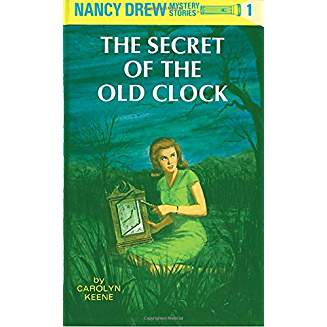
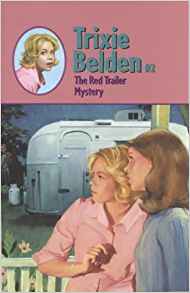
I love a good mystery. Doesn’t everyone? Ever since I “discovered” Nancy Drew and Trixie Belden I have been a mystery fan.
Mystery

Back in those days, when I spent whole summers reading nothing else, I was obsessed with finding real mysteries wherever I looked. I recall riding bikes with a friend out on the gravel road to the cemetery, stopping along the way to search for clues in the ditches, roadside, and, of course, in the cemetery.
Mystery

We found beer cans, pop bottle lids, candy wrappers, an occasional shoe or car muffler. We tried to build mysteries around these things. Somewhat unsuccessfully. Whose car was making a lot of noise lately? Which high school boys were most likely responsible for throwing the beer cans out their car window? How many females in our town wore a size 7 shoe, and who was missing one?

More Complex Mystery
Mystery

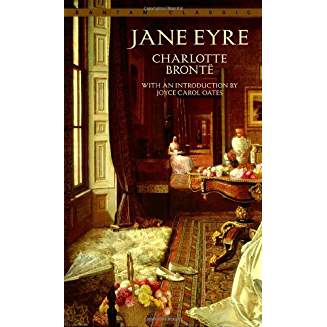
As I aged out of Nancy Drew, classics replaced mysteries as my preferred reading. But the mysteries persisted. Who is the crazy person living in Mr. Rochester’s attic? How many secrets are there in The Scarlet Letter?

History Mystery

As I matured, I grew more and more passionate about history. I realize that history is full of mysteries. Research helps uncover not just events that happened long ago. It sheds light on the people who participated in those events, along with their desires and motives. How did they live? What were they trying to accomplish?
Mystery

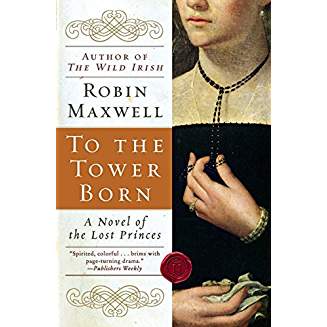
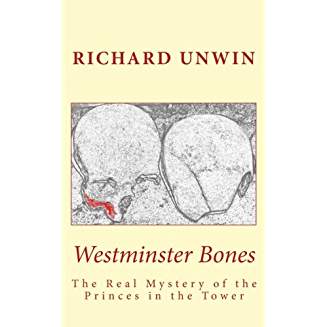
We know that Edward IV’s two young sons vanished from the Tower of London, but it was a mystery for many years if and how they died, and is still debatable who was responsible. Did Richard III kill his nephews?  Shakespeare immortalized that version. Or was it done through Margaret Beaufort to put forward her son Henry Tudor (who became Henry VII) as heir to the English throne? Or maybe it was Richard’s wife to ensure the succession would come down that line? It is still a mystery waiting to be solved.
Mystery


Mystery Historical Fiction

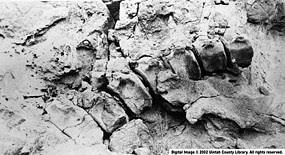
Classics and my love of history led me to reading historical fiction, and even there, I’ve found mysteries. A paleontologist dug up dinosaur fossils in Centennial by James Michener and solved a murder from an earlier century.
Mystery

I’m a fan of historical fiction mysteries. I love the Brother Cadfael mysteries by Ellis Peters with his medieval monk sleuth. C. J. Sansom has Matthew Shardlake as a Tudor era detective. Right down my alley! Elizabeth Peters amuses me with Amelia Peabody and her Egyptian archeologist adventures in the Valley of the Kings.
Mystery


Mystery Fiction

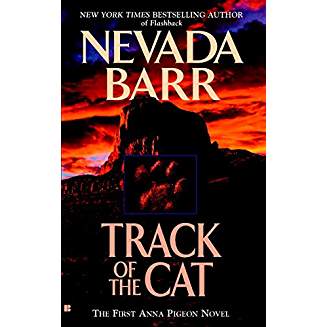
Nancy Drew has even reappeared in my life. Of course, now she looks like National Park Ranger Anna Pigeon in Nevada Barr’s works. Or Dr. Kay Scarpetta in Patricia Cornwell’s forensics. Or Kathy Reichs’ Temperance Brennan. Or maybe even madcap Stephanie Plum in Janet Evanovich’s novels.
Mystery

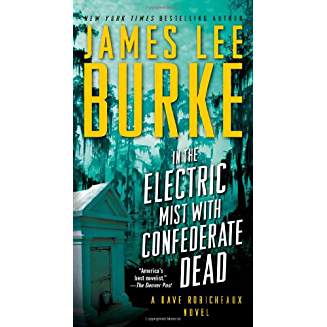
Contemporary mysteries, with their flawed but admirable solvers draw me into their worlds, too. James Lee Burke’s Dave Robicheaux is at the top of this list. Sheriff Walt Longmire and Game Warden Joe Pickett, characters created by Craig Johnson and C. J. Box, respectively, fall into this category. They appeal to me with their Wyoming locales in the Big Horn Mountains. Tony Hillerman, P. D. James, Louise Penny, Elizabeth George, Aaron Elkins, and so many more, right back to Sherlock Holmes, tempt me to spend time with them.
Mystery

Why are mysteries so popular? I believe it is because they all appeal to the human desire for justice and to our natural curiosity. In the real world, we usually find out who has been killed, and maybe the cause of death. But the other questions are less surely answered. “Whodunit”, how did they do it, and why did they do it, are not always answered to our satisfaction in true life.
Mystery

But remember, some crimes take a hundred years to come to light, when a paleontologist digs up human bones along with a dinosaur fossil…

 

What’s On Your Bookshelf? Reflections of Yourself

What does my bookshelf say about me?  I read an article in the Omaha World Herald a few weeks ago that spoke of how a book collection reflects the person who owns it.

Do I need more science fiction and mystery in this bookshelf?

My Bookshelf

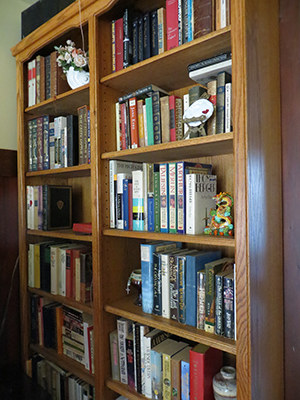
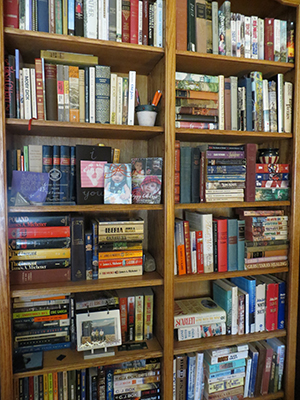
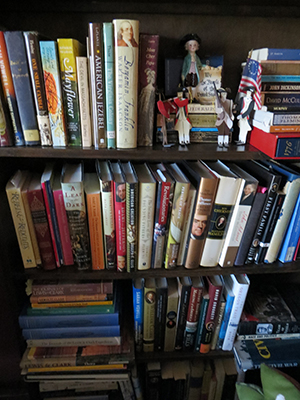
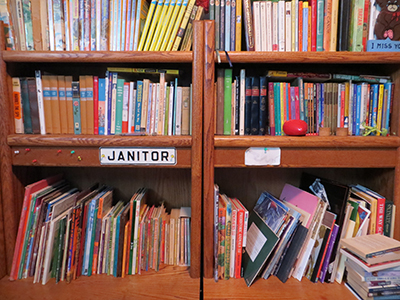
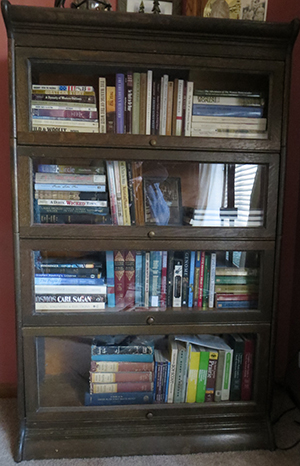
I walked through my house, pouring over the titles on each bookshelf. My eclectic collection reflects a lot of disparate interests. Two double-wide, seven-feet-tall shelves line my family room. Two four-shelf cases grace my living room. Three tall shelf units (the type you can buy at Shopko) line my basement family room. Other shelves hold kids’ books. And all are full, even though I cull them annually for our church garage sale.

Is this enough Plains history and science?

My Bookshelf

The first and easiest thing my bookshelves say is that I probably own too many books! I may be a book hoarder. At the very least, I have trouble parting with books I have loved, books with beautiful bindings, books about my favorite subjects, books I want to read again, and books I mean to read soon. Books fill each bookshelf fairly well, and I find it more difficult every year to fill a box for the rummage sale.

I could use more world and English literature in this bookshelf…

My Bookshelf

My shelves also tell of my background working in libraries and bookstores. Being the daughter of a librarian, my books are shelved by genre, author, or time frame, of course. Two of the basement bookshelf units contain science fiction/fantasy, while one contains mysteries. The living room units are full of historical nonfiction and science. The shelves in my family room are divided into world literature and English literature on the north, while American literature and fiction overflow on the south.

I can never get enough American historical novels…

My Bookshelf

How old was I when I first read of Elizabeth and Darcy? Who was that professor who helped me see the inner beauty of Wordsworth’s poems? How much better would my term paper about Thomas Jefferson be if I wrote it today? What interesting worlds can be created by authors who let go of the world as we know it? Don’t I need another book about Lewis and Clark? What’s the newest National Park adventure by Nevada Barr? When will Sheriff Longmire run into Joe Pickett?

Anyone for some historical nonfiction?

My Bookshelf

The books on my bookshelf follow my own footsteps through life. Thornton W. Burgess, The Boxcar Children, Louisa May Alcott, Trixie Belden, Nancy Drew, and Anne of Green Gables were my childhood friends. I graduated to Bronte, Austen, Elswyth Thane, Mary Stewart, Neville Shute, and A. J. Cronin. Then I found Michener. Oh, the glory of Michener – start at the very beginning and leave nothing out!

Don’t judge me for my affinity for children’s books!

My Bookshelf

I favor all books about King Arthur, many novels about the Tudors, early American history – fiction and nonfiction, Nebraska and western history and fiction, science fiction and fantasy, mysteries, and religious fiction. With the recent explosion of young adult fiction, I find myself drawn to them for fantasy page turners when I don’t have much time. But I am apt to choose almost any genre, depending on my mood.

I guess my bookshelf collection proves that it’s not so important what I’m reading as it is that I am reading! And I am a book hoarder.


Historical Nonfiction – The Blood of Avalon – King Arthur –

The Blood of Avalon – The Secret History of the Grail Dynasty from King Arthur to Prince William By Adrian Gilbert –   Adrian Gilbert believes that he can trace the ancestry of England’s Prince William back to King Arthur … Continue reading

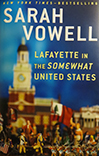
Lafayette in the Somewhat United States

Lafayette in the Somewhat United States

Lafayette in the Somewhat United States, by Sarah Vowell

Lafayette is the subject of Sarah Vowell’s newest work of non-fiction. She chose him for a number of reasons, but her choice was solidified by an incident during her initial research. Someone had inquired what her new project was to be, and when she said it was Lafayette, the person replied, “So you’ll be spending a lot of time in Louisiana.” Upon explaining, the person still didn’t seem to know who Lafayette was, and this reinforced the idea that it was time for him to be the subject of a best-selling book.

After reading Lafayette in the Somewhat United States, I had a similar reaction when I reported on this delightful book at a book club meeting. Members asked, “Is this a fictional person?” and “Who was Lafayette? I’ve never heard of him.” I was aghast just like Sarah Vowell, and proceeded to give them some background.

Who was Lafayette?

The life of Lafayette, who became the Marquis de Lafayette upon the death of his mother and grandfather when he was only twelve years old, is a tale of the political and military events of the late 18th and early 19th centuries in both France and America. Vowell begins with his 1824 thirteen month tour of the United States as last living general of the American Revolution. This illustrates how important to the United States Lafayette was, and how beloved by the populace, no matter their politics. Eighty thousand fans turned out to welcome his arrival in New York. The population was only 123,000 at that time. And huge crowds turned out all along his twenty-four state tour. He was the one thing all Americans could agree on.

Lafayette in our Revolution

In 1777, at the age of nineteen, this rich French aristocratic general left his young wife to come to America to aid in our fight to get rid of the British. His father had been killed in one of the many battles France fought with England in the Seven Years War. So hatred for England came to him at a young age, and his studies had reinforced the new democratic ideas. Once given a place within our Continental Army, Lafayette showed an eagerness to learn and natural ability. He became what Vowell calls a “chummy minion” to George Washington and was given a command of his own eventually.

During the war he wrote letters to people in France pleading for financial and military aid to the struggling country. Historically speaking, there might not have been a United States at the Revolution’s end without the assistance of the French. Washington and Lafayette were responsible for trapping Cornwallis in Yorktown, Virginia. But the French navy fleet was responsible for keeping them from escaping by sea.

Lafayette in his own country’s Revolution

Lafayette continued helping the United States in the 1780’s. We were in need of trading partners to replace those we lost when the British left our shores. He had returned to France by this time and had many powerful friends in government and commercial circles. While Thomas Jefferson was serving as minister to France, he and Lafayette became good friends and worked on trade agreements. Jefferson helped him when France began its journey towards democracy. Later, when the French Revolution turned on its own leaders with aristocratic connections, the U. S. helped Lafayette flee his own country. They later aided in saving his wife and family as well.

Lafayette’s return to America

Lafayette had fond memories of the successful revolution in America. Though a man of sixty-six by then, he agreed to the extended tour of the U.S. when invited by James Monroe. Throngs greeted him everywhere he went. They reminded him of the love he had for the United States, the country that he had helped found.

America returns the favor

France gave us the Centennial birthday gift of the Statue of Liberty, as a memorial to our alliance with them during the American War for Independence. And when the American Expeditionary Forces under General Pershing landed in France in World War I, they marched to Paris on July 4, 1917 and went directly to Lafayette’s tomb. They draped an American flag over his tomb, made a speech that spoke of our alliance with France, and finally said, “Lafayette, we are here.” Buried in a cemetery used as a mass grave during the Reign of Terror in the French Revolution, the dirt that covers his grave came from Bunker Hill.

Today, there is ceremony on the Fourth of July at Lafayette’s grave in Paris. Representatives from both the French and U. S. governments and militaries, along with his descendants, swap the American flag flying over his grave for a new one every year. At least some of us remember who he is.  Sarah Vowell, in her usual witty way, has ensured that more will remember him in the future.